

Artificial Intelligence (AI) is reshaping how buyers discover and evaluate renewable energy and cleantech companies. Instead of relying solely on traditional search engines, decision makers are increasingly using AI platforms like ChatGPT, Gemini, and Claude to research vendors, compare solutions, and shortlist potential partners. As Tigercomm noted, as much as 95% of the B2B buyer's journey now happens inside AI tools, fundamentally changing how companies build visibility and influence purchasing decisions.
For cleantech companies, this shift creates a unique challenge. Many early-stage businesses operate in emerging markets, or have a limited digital footprint. Without a strong presence across trusted publications, industry conversations, and other authoritative third-party sources, they risk being overlooked by both AI-powered search and prospective buyers.
A recent Muck Rack study analyzing more than 25 million AI citations found that earned media drives 84% of results AI systems rely on, highlighting the value of third-party credibility. This earned media doesn’t stem from occasional press releases over the wire. It requires a strategic PR program that consistently generates original reporting, builds strong rapport with journalists, and positions your company as a trusted voice within the industry.
For over two decades, Tigercomm has helped renewable energy companies build and run successful PR campaigns. Pulling from those experiences, this guide explores the core elements of an effective cleantech PR strategy. It covers strategic planning, stakeholder engagement, media relations, and the key considerations for choosing the right PR partner to support long-term business growth and AI-era visibility.
5 Key Takeaways for Renewable Energy PR Strategy
-
Start with the business goal. Identify the outcome you want PR to support, then tailor your message to your audience, since their pain points, objections, and priorities will differ by group.
-
Original insights and strategic PR are what set you apart. This is becoming increasingly important as energy technology competition intensifies and demand for electricity creates more competitors.
-
Earned media builds trust advertising can't buy. When a customer, congressional staffer, or investor researches your company on Google or ChatGPT, they should find credible external sources talking about your business, not just your own website.
-
PR fuels everything else. News coverage becomes social content, marketing material, and SEO signal, since search algorithms increasingly reward outside validation.
-
Start early to get ahead of community opposition. Local opposition can kill a clean energy project before it breaks ground, so proactive communication with communities matters as much as the engineering behind it.
The value of PR for renewable energy companies
Renewables have been competitive for a while; in fact, they’re expected to overtake coal as the largest global energy source by 2025. But that doesn’t mean cleantech companies can push PR and marketing to the wayside. Fossil fuel companies continue to spend millions on advertising as the threat from disruptive clean energy technologies grows. The renewables industry might not have the same budget, but a solar, wind, storage, hydrogen, or other clean energy startup can at least get on the competitive field with incumbent energy corporations by creating a strategic renewable energy public relations campaign.
Understanding Cleantech PR Strategy
A cleantech PR strategy isn't fundamentally different from PR strategy in any other industry: the goal is still to differentiate your company and earn attention from an important audience that advertising can't buy.
We think about coverage as an "attention meter": who's speaking (your platform), what you say (your content), and how you say it (your style). The safer and more boring an announcement is, the less likely it earns coverage; the riskier and more interesting, the more likely it stands out. For most renewable energy companies without a boldface name to lean on, content is the lever that matters most.

A few ways to put that into practice include turning your own data into marketing insights, giving your news a human face, or handing reporters a media kit that makes their job easy. Regardless, the goal is the same: make it effortless for someone else to find your story interesting. At the end of the day, the companies that earn attention are the ones willing to tell their audience something new, not just talk about themselves.
The Value of Strategic PR for Renewable Energy Companies
The Business Value of PR
Strong PR doesn't just build awareness over time, it can create a step change in how a company is perceived by the customers and investors that matter most. Outside validation makes a company's progress visible and credible in a way internal updates never could. This is the business value of PR.
Key Benefits of Adopting a Strategic PR Approach
-
Why Is Consistent PR Important for Building Visibility?
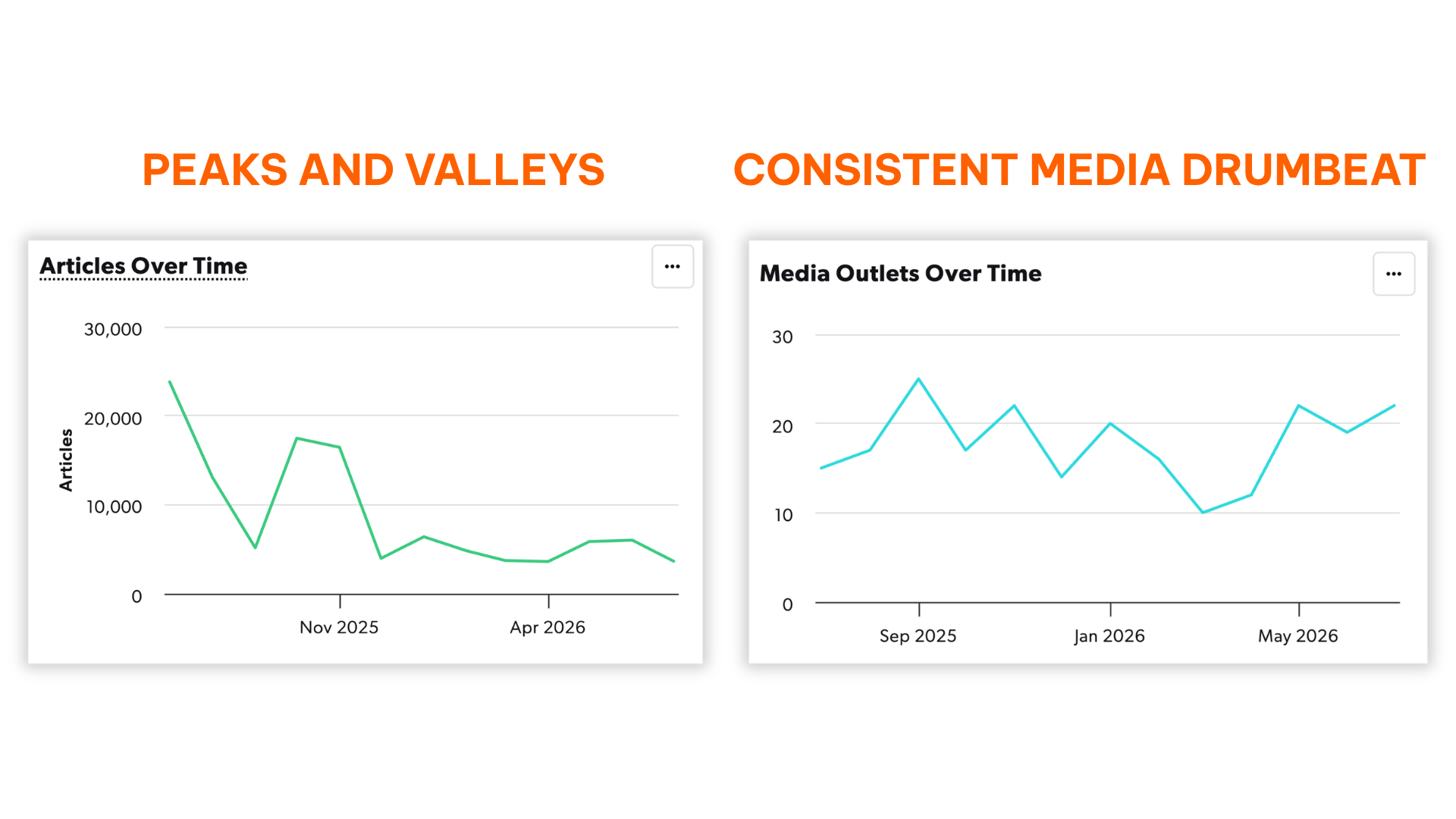
Search engines, industry media, and AI assistants reward companies that communicate consistently, rather than rely on sporadic press releases or occasional announcements. Strategic PR builds visibility and credibility that compound over time. When a prospective customer reads a quote from your CEO, sees AI cite your research, and later comes across one of your thought leadership LinkedIn posts, each piece helps reinforce the last. Instead of becoming a company they “might have heard of,” you establish yourself as a credible, consistent voice in the industry. Random, intermittent communications don’t compound. Strategic PR does.
- How Do You Decide Which Industry Topics to Comment on?
Strategic PR concentrates attention on the topics that matter the most. Trying to comment on everything only dilutes your authority. With all the digital noise and content crowding the internet today, particularly with AI-generated material, companies must be intentional about which discussions they join.
Tigercomm helps our clients identify the most salient content by going through a strategic messaging and in-depth-interview process. We work with your executive and sales team to understand the buyer’s journey (or the investor’s journey) and identify predicates, questions, objections and pain points that can become the source of content.
By consistently communicating around a select number of strategic topics, you build expertise in the areas that customers, investors, and stakeholders care about the most. Learn more about the importance of topic selection in our article, The Three Drivers of Attention.
- Why is High Quality Media Coverage More Valuable than a High Volume of Mentions?
Not all attention is made equal. Success is not achieved by maximizing media placements, but generating attention in the specific outlets that influence customers and investors. Strategic PR helps build credibility needed to secure coverage in high-value publications, where a single placement can be more impactful than dozens elsewhere. You can read more about why the "spray-and-pray" strategy fails in our article, Cleantech Marketing: Strategies, PR Tips, and Mistakes to Avoid.
Core Elements of an Effective Renewable Energy PR Strategy
The old ways of thinking have changed. With the advancements of SEO and AI search, we encourage our clients to put out a steady drumbeat of updates, from project milestones to funding announcements, even if they aren't big enough to pitch to a reporter. In the pre-AI era, we would generally counsel clients to be selective about which updates they shared with the media and avoid watering down their message. That was when journalists were the primary drivers of industry perception. If an announcement wasn’t newsworthy enough to earn coverage, it was highly unlikely to reach your audience and risked undermining your credibility. Today, those same announcements still may not find their way into the inbox of a top reporter, but they will nonetheless strengthen the digital footprint that puts your company’s name into web search results and AI responses.
Here are core elements that make up a strong earned media story:
- A third-party expert builds credibility. An unpaid outside voice, like an analyst or academic, gives reporters something to work with, and can turn a short story into a full feature.
- A big name or platform raises the stakes. A tie to something already recognized, like Google, Tesla, or the Federal Reserve gives a story built-in relevance.
- Original research should be about your audience, not about you. The best data reveals something new about the people you're trying to reach, not just a stat that flatters your company.
- A human, specific positive outcome makes a story relatable. A family-run business or a feel-good community angle helps readers connect beyond the numbers.
- A quote they cannot resist. A short, memorable quote catches your audience's attention. Give reporters something with punch: a surprising claim, an idea that goes against the grain, or a provocative perspective that makes for a gripping headline.
How to Build a PR Strategy for Renewable Energy Company
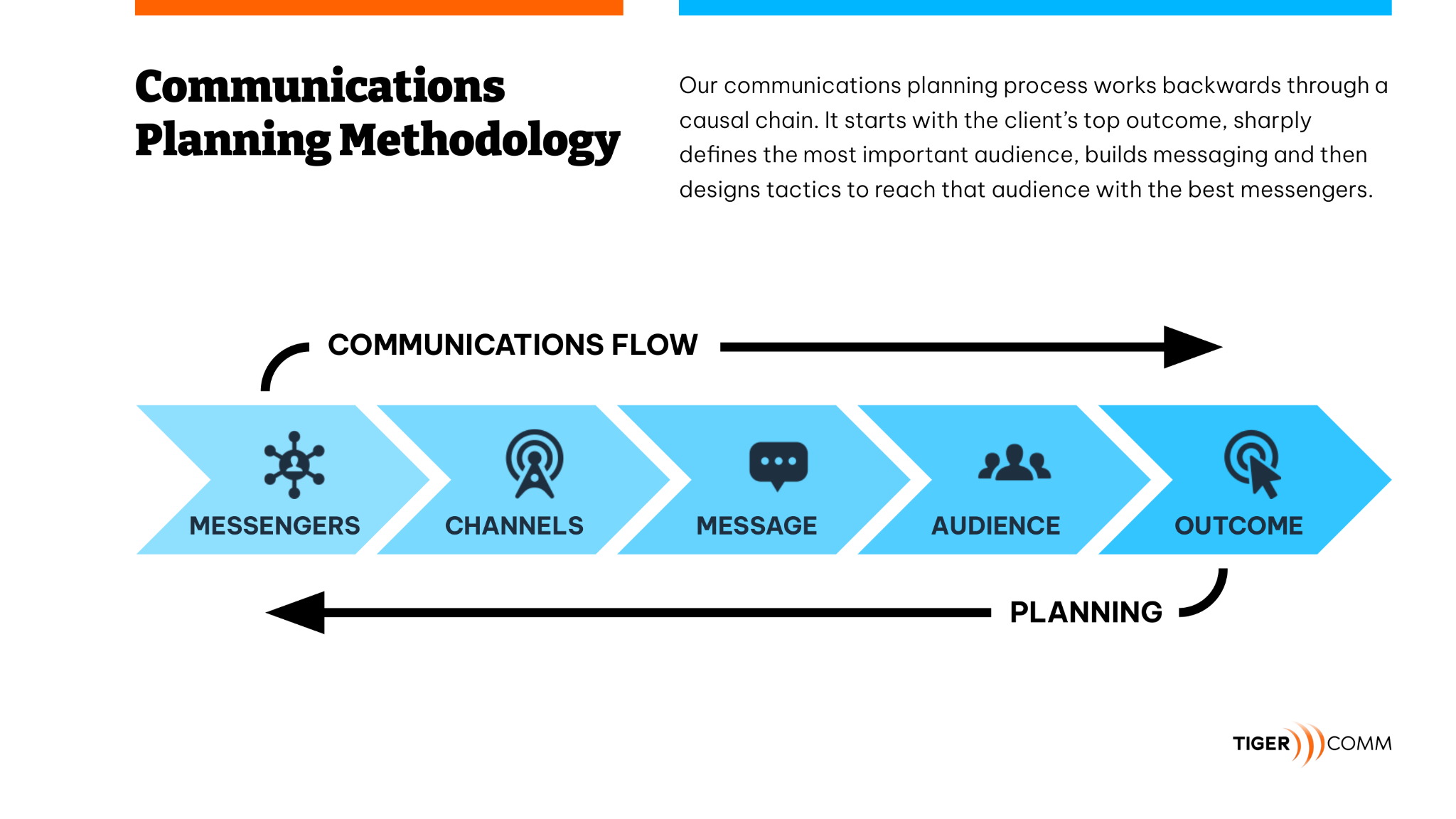
Step 1: Define Business Objectives
Whenever we start a project at Tigercomm, we begin with the end in mind. We challenge our clients to drive agreement on the top business goal that communications can support because it is only then that we can build an effective strategy. Many companies come to us because they are either looking to boost sales, or grow their company's valuation with investors or markets. Those two goals, while related, have different target audiences, which creates a cascading effect on message and strategy.
Step 2: Identify & Prioritize Audiences
Once we’ve gotten agreement from the leadership team around the top business goal that communications should support – AKA – “What do you want?” Then we can determine who can give it to you, that is your priority target audience. Many renewable energy and cleantech companies are dealing with a variety of important stakeholders: customers, partners, investors, regulators and employees. However, it is important to laser focus on the top priority when determining the best messages and channels to reach that audience. Investors may be reading different materials and have different pain points and objections than customers. We work with our clients to deeply understand all of these audiences so we can tailor-craft a strategy to meet their needs.
Step 3: Conduct Messaging Session & Craft Elevator Pitch
Once we know the top business goal and the customers you’re trying to reach, we bring your team together for a message development session. During the session, each participant brainstorms ideas individually and then we then collect everyone's results and facilitate the group in agreeing on the three concepts that matter most. This is effective as teams that help shape their own message use it at a far higher rate. Afterward, we condense all three into an elevator pitch that summarizes your entire value proposition in one compact message.
Common Challenges with Renewable Energy PR
For developers facing local opposition, early engagement can make the difference between a stalled project and a successful one. Tigercomm's approach to community engagement helps renewable energy projects and data centers build that support from the start.
Renewable energy projects rarely fail on engineering grounds. They are much more likely to be killed at the town hall meeting based on perceived community concerns. A vocal opposition group, often organized on Facebook and sometimes backed by fossil fuel interests, can stall or kill a project before it breaks ground by spreading disinformation about its impacts. Inside Climate News recently traced how this kind of opposition became more organized. The pattern shows that building the project is not enough.
Community Opposition & Stakeholder Engagement
Community opposition can put a stop even to well-designed renewable energy projects, especially when a small but organized group dominates the local conversation. A strong renewable energy PR strategy should include early stakeholder engagement, local influence mapping, and trusted validators who can help build support before misinformation or opposition hardens. Tigercomm's community engagement services are built to help developers win that support before opposition takes hold.
Misinformation and Public Perception
Misinformation spreads quickly in polarized local environments, especially around health, land use, property values, energy costs, and environmental impacts. Renewable energy companies need a proactive communications plan that corrects false claims, answers community concerns in plain language, and ensures local officials hear from supporters as well as critics.
Regulatory and Permitting Challenges
Permitting is not just a technical process; it is often a political campaign shaped by local relationships, public sentiment, and decision-maker pressure. Effective renewable energy PR helps developers understand the local political landscape, prepare for key approval moments, and build the visible community support needed to move projects from application to construction.
Crisis Communication
When opposition surges or a project faces negative coverage, developers need a rapid-response plan that lowers the temperature rather than escalating the fight. Crisis communication for renewable energy projects should diagnose the source of concern, correct the record, elevate credible local voices, and keep stakeholders, officials, and media informed with consistent, fact-based messaging.
Why Renewable Energy Companies Need Specialized PR Support?
You want your company's story showing up where your buyers and investors are actually looking, and for clean energy, that means a combination of business and financial media alongside industry trade publications for solar, energy storage, and the wider clean energy sector.
Getting your name in a national outlet might feel good, but what actually drives the business forward is reaching the customers and investors through the publications they already read and trust. Trade coverage also tends to go deeper than a general audience story ever could, and these reporters often understand the industry better than anyone else covering it, which makes them credible validators in a way broader outlets can't always match.
That's why the PR firm you choose matters. A specialized agency understands the media landscape of the industry: what outlets your target audience actually reads and which reporters cover what. They bring stronger connections with those reporters and editors, along with a higher understanding of subject matter that shows up in every pitch they make.
How to Choose the Right Clean Energy PR Partner
Agency Size and Structure
Agency size can be viewed as a spectrum. On one end, large global firms offer broad capabilities and multi-market presence through a single point of contact. However, they often come with high fees and the risk of “bait-and-switch” staffing, where senior partners bring great ideas to your pitch meeting, but hand the actual work to inexperienced junior staffers. This can result in cookie-cutter execution and slow communication—all for the price of top-tier expertise. This model can work well for larger enterprises, like Fortune 500 companies, whose communications budgets justify the premium fees that guarantee them all the promised capabilities and senior talent.
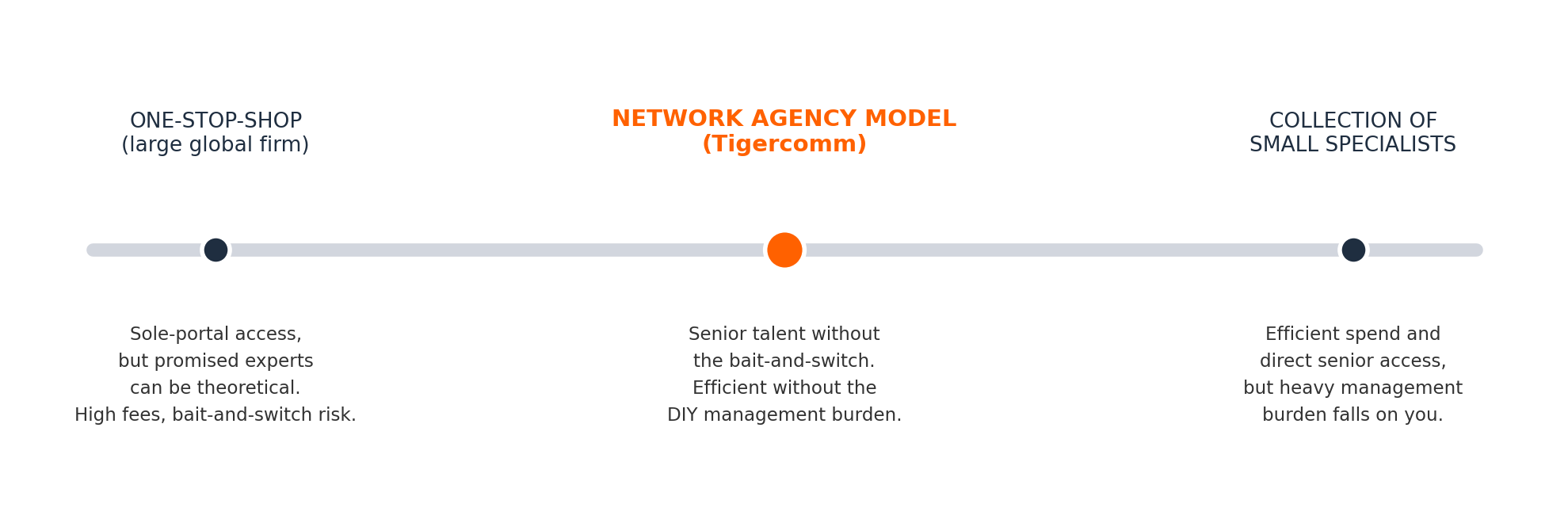
On the other end are multiple small, specialized firms that are often cost efficient and provide direct access to senior staff, but with the burden of recruiting and managing multiple vendors. In the middle is Tigercomm’s network agency model, which combines the advantages of both ends of the spectrum: reliable access to senior talent, specialized capabilities, and cost efficiency, all from one firm. Tigercomm brings 125 years of combined experience to client strategy and execution.
Pricing and Value
While the agency size is often interconnected with pricing, it is still important to consider how an agency’s cost structure corresponds with your budget, expectations, and company goals. When working with communications agencies, you might come across a variety of different fee structures such as monthly retainers, project-based fees, performance-based fees, and hourly rates, which will vary depending on the firm and the project. Ideally, the best structure is what serves your needs best, one that’s flexible and built around capabilities you need.
Rather than focusing on cost alone, understand the value you gain with the investment. Know what you are getting for what you are paying for. The right pricing model should give you confidence that your investment is achieving significant communications and business outcomes, not just adding to your overhead.
Strategy and Execution
When looking for a new firm, companies should decide whether they want a PR partner that can bring original ideas to the table or an extension of their in-house communications team. There is nothing wrong with hiring a communications firm simply to follow directions and supplement internal staff. But companies often benefit most from agencies that provide both execution muscle as well as new expert perspectives and creative problem solving. Good communications agencies don’t just carry out requests, they bring original ideas to the table, challenge assumptions, and use their expertise to make recommendations that support your goals.
Industry Expertise and Results
Another factor to consider when evaluating potential communications partners is whether or not they have a track record of bolstering visibility, positioning companies as trusted voices, and creating lasting improvements in communications programs. Research if the firm has successfully worked with companies at a similar stage and with similar business objectives.
In order to earn coverage where it matters, deliver communications results efficiently, it is crucial that your PR partner has a profound understanding of your industry, audience, and business challenges. As the market for renewable energy grows, many larger PR agencies are entering the cleantech space. While these agencies may have proven track records in other industries, their newer clean energy practices may have little experience working in renewables. Specialized Agencies like Tigercomm can offer a more robust set of strategies, greater industry knowledge, and a deeper Rolodex of connections in the clean energy industry. Our client success stories show what proven results look like.
Media Relationships and Credibility
Strong PR agencies have established relationships with the journalists, analysts, and industry influencers that matter to your audience. Just as importantly, they know what makes a story actually newsworthy and how to turn your announcements into captivating stories that reporters want to write about. The blend of being well connected with the media and providing sensible editorial insights is what makes the difference between simply garnering mentions from the media and securing valuable reporting. The right agency knows which publications influence your stakeholders and how to get your message there.
Any firm can claim that they have “strong relationships with the media,” but how do you actually know? It’s important to ask the right questions. Where have they secured coverage for previous clients? Do they release content that attracts industry journalists themselves? Agencies that frequently release original research, contribute to industry conversations, and maintain visible relationships with journalists almost always are far more credible and well connected than those that opt for traditional pitching. Tigercomm, for example, has built media relationships by regularly featuring journalists from 40 leading outlets across the world over 140 episodes of news roundup it co-hosts, This Week in Cleantech.
Culture, People, and Approach
The agency-client relationship is a partnership, so finding a team whose communication style, values, and working approach align with your own is vital. The best agencies are open, responsive, and invested, putting in the time to familiarize themselves with the inner workings of your business while assisting your existing internal team. Strong synergy between a company and their communications partner can allow for more effective collaboration, stronger ideas, and quicker execution.
To understand a firm's culture, you need to look beyond the polished statements on their “about us” page. Read employee reviews, browse the firm's thought leadership content, listen to podcast appearances, and see what the executives post on media platforms such as LinkedIn. These various touchpoints can often paint a more accurate picture of the agency's culture, values, and priorities when working with clients—whether it underscores collaboration, strategic thinking, innovation, or simply execution. At Tigercomm, this is reflected in our “3D Rule”: no drama, no dysfunction, and no dishonesty. It’s a commitment to “keeping the floor clean” that applies to our work with both clients and each other.
Tigercomm: A Leader in Clean Energy Public Relations
Tigercomm is the U.S.'s top cleantech PR and marketing firm. For 23 years, we have worked at the intersection of clean energy, corporate communications, public affairs, and thought leadership, helping more than 190 companies across solar, wind, battery storage, lithium refining, SaaS, and construction. More than 2,300 people have gone through our message and media training, sharpening how clean energy leaders communicate under pressure. We also produce This Week in Cleantech, a weekly roundup now at 140 episodes, keeping us and our clients on top of the trends shaping the industry.
A Track Record with Industry Leaders
Our client roster includes some of the biggest names in clean energy. From securing funding rounds to protecting market leadership positions, our strategic approach has helped companies across the clean energy sector achieve measurable, lasting results.
Capital Raises & Growth
- Rondo Energy — Helped secure funding; global sales built across three continents.
- NextPower— Shaped company narrative ahead of an IPO that became the most successful in solar energy's history.
- PVcase — Boosted M&A deal flow for this Lithuania-based SaaS company.
Defending Market Leadership
- Vestas — Marketing and policy communications that protected the company's position as industry sales leader through its record-setting 2GW turbine sale.
- Trina Solar — Helped double inbound lead flow and sustain a top-5 U.S. sales position for three years over the course of an 11-year engagement.
- Areva — Helped the Khosla- and Kleiner Perkins-backed CSP manufacturer boost its sales price by $50 million.
Shifting Market Perception
- LG — Boosted marketing budget efficacy 25% during the pandemic by repositioning solar as a home-security investment.
- E.ON — Built a go-to-market strategy for a new wind farm O&M service line in an emerging market.
- Atlas Renewables — Executed messaging, brand, and project pipeline for this Miami-based Latin American developer.
Policy & Community Engagement
- EDP — Lead a multi-company initiative reducing rural resistance to solar — the #1 barrier to U.S. clean energy deployment.
- RWE — Part of the same multi-company initiative.
- AES — Ran a milestone construction event securing Arizona's governor and top utility regulator as public supporters.
What We’ve Built for the Industry
We didn't just conduct regular public relations by pitching stories to reporters. This Week in Cleantech and Scaling Clean, a leadership podcast pulling lessons from experienced CEOs in the sector, are two of the ways we built our own media presence. We regularly convene cleantech journalist roundtables, bringing together the reporters who cover our industry. Our original research gets publicly released and has been covered by outlets like CNET, and we share new marketing tactics with the sector as we develop them. We helped found the Cleantech Leaders Roundtable, a network connecting investors with the companies raising capital.
Together, these assets strengthen our credibility and expand opportunities for our clients.
Coverage in the Outlets That Matter Most
see the cleantech industry. We have generated stories in the Wall Street Journal, Bloomberg, the Financial Times, The Economist, S&P Global, and CNBC. Our reach extends into tech and innovation media too, with coverage in outlets like TechCrunch, Wired, The Verge, and MIT Technology Review. We have also landed clients on the cover that included Rondo Energy's decarbonization technology, featured in Ethanol Producer Magazine.
Conclusion
A strong renewable energy PR strategy creates business value by proving a company's credibility to investors and customers. As the industry becomes more competitive, that credibility is what separates companies that get noticed from those that get overlooked. That's what a good strategic PR campaign is about: turning your expertise into credibility, your credibility into attention, and that attention into business results. For over two decades, Tigercomm has helped clean energy companies do exactly that.
The first step is defining what you want PR to achieve: the outcome, the audience, and the message that speaks to them. Once that's clear, we can help you build the strategy to get there.
Book a discovery call with Tigercomm today.
Frequently Asked Questions
Author Biography:

Melissa Baldwin is Tigercomm's Senior Vice President with 20+ years in energy and climate communications, specializing in media relations, public affairs, and energy policy. She previously founded Chase Media Services, a sustainability-focused PR firm acquired by Tigercomm in 2021, and has held communications roles at the Southern Alliance for Clean Energy and Hill + Knowlton Strategies.